Lunar Eclipse (October 27, 2004)
 Fig. 1. The fully eclipsed Moon had a reddish orange color. This photo was taken on 2004 October 27 at 23:06 EDT (local time) from the driveway of our house in Cockeysville, Maryland, around the time of the midpoint of the eclipse.  Fig. 2. A lunar eclipse happens when the Moon passes through Earth's direct shadow, called the penumbra. 
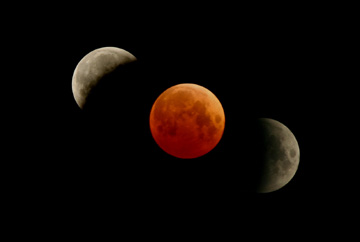 Fig. 4. A composite of three frames from the time-lapse movie in Fig. 3 showing the beginning, middle, and end of the eclipse. This composite demonstrates the round outline of Earth's shadow in space and the Moon's appearance while in this shadow. |
End of a Lucky Streak On average, total lunar eclipses happen approximately once in every 17 months. But if you lived in the 17-month period between May 2003 and October 2004, you might have thought they happen much more frequently, because 4 total lunar eclipses occurred in this period. Three of these eclipses were visible from most of North America, which included the driveway in front of our house in Cockeysville, Maryland. As luck would have it, clouds obscured the first two eclipses, but we got lucky for the one in October 2004--the last total lunar eclipse for North America until 2007. In the middle of the eclipse, the Moon appeared dark reddish orange (Fig. 1). Although Earth blocks all direct sunlight from reaching the Moon during a lunar eclipse (Fig. 2), some sunlight is scattered by Earth's atmosphere and does reach the Moon. This reddish light is the same as that you might see on Earth after a sunset. Part or all of the Moon was in Earth's shadow for over 3.5 hours. If you watch the whole event (Fig. 3), you can get an idea of the size and shape of Earth's shadow in space (Fig. 4). More information about eclipses can be found on NASA's eclipse page. The equipment we used to capture the event is outlined below.
(  back to home page) |
back to home page

