Solar Eclipse (March 29, 2006)
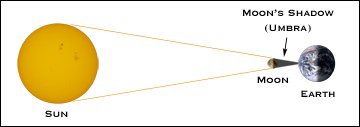 Fig. 1. A solar eclipse happens when the Sun and Moon are in exact alignment so that the Moon's shadow falls on Earth.  Fig. 2. The narrow path (blue) of the 2006 solar eclipse swept through coastal Brazil, Northern Africa, Asia Minor, and Russia. (Source: Espenak F and Anderson J. Total solar eclipse of 2006 March 29. NASA report TP-2004-212762.)  Fig. 3. We set up our equipment at a location on the Turkish Mediterranean coast (show Google map). (Photo by John S.) 
 Fig. 5. A photograph we took of the solar eclipse, similar to those typically published in newspapers and magazines. This type of photograph shows only a part of what is visible to the naked eye.  Fig. 6. A composite of 10 photos of the solar eclipse that we took with a progression of exposure settings (see Fig. 7). This composite more closely resembles the great range of brightness in the Sun's corona that was visible to the naked eye. (See larger image.)  Fig. 7. The 10 individual images that were used to compose Fig. 6. The exposure setting was doubled for each successive image. |
Brief Escape from the Normal World About every one or two years, the Moon lines up exactly between Earth and the Sun. When this happens, the Moon blocks all direct sunlight and briefly casts its shadow on Earth's surface. If you happen to be standing exactly in the center of this shadow, you experience a total solar eclipse (Fig. 1). For a solar eclipse to occur, circumstances have to be just right because the Moon is barely big enough to cover the Sun. Even when the right aligment occurs, it's not easy to see an eclipse because it's not easy to be standing exactly in the Moon's shadow. The shadow usually touches Earth for only a few hours. The shadow is small and moves along a narrow path (less than 100 miles wide) at about 2000 miles per hour (Fig. 2). Therfore, the shadow covers a location along its path for only a few minutes. Finally, the weather must be cloudless for the eclipse to be observable. We joined a tour group travelling to Turkey for a chance to see the solar eclipse. The tour was composed of a mixture of eclipse rookies like us (who had never seen a solar eclipse) and experienced "eclipse chasers" (we met someone who had seen 11). Our observation site was on the beach in front of our hotel facing the Mediterranean Sea near Antalya, Turkey (show Google map). We were very lucky with the weather. The sky was clear for the entire eclipse event except for a very few high, thin cloud wisps. One Photo Is Not Worth a Thousand Words As on our trip to see the Venus transit, we brought along equipment (Fig. 3) to photograph the event. But the photographs (Figs. 4-6) only represent one aspect of the solar eclipse experience. Here is a brief log of our other observations: 9:00 am (about 5 hours before totality). We began to set up our photographic equipment, as did a few other amateur photographers in our group. In order to save weight, we had a homemade wooden tripod to support the telescope mount. The mount and camera had to be battery-powered, and the homemade battery pack doubled as the mount's counterweight. The result was an unusual contraption that drew a lot of attention from members of other tour groups. Many wanted a picture of us standing by our contraption. 12:40 pm (about 90 minutes before totality). The Moon began to cover the Sun. This phase is called the partial eclipse. Even when partially covered by the Moon, the Sun is so bright that there is no noticeable difference on the ground. 1:25 pm (about 30 minutes before totality). More of the Sun was covered by the Moon as the partial eclipse phase continued. We began to notice that the temperature felt cooler. In fact, someone with a thermometer recorded a 14-degree (Fahrenheit) drop during the eclipse. 1:40 pm (about 15 minutes before totality). The landscape was becoming noticeably darker. It was as if we were looking at everything through sunglasses. Shadows became sharper, giving the impression that you were seeing things more clearly. If you didn't know something big was going to happen, you did now! The Sun was dimmer, but it still appeared as a glaring portion of the sky. A solar filter was still needed to look at the Sun. 1:54 pm (seconds before totality). Suddenly, the glare of the Sun was gone and a brilliant radiance of light appeared. This is the last bits of Sun as viewed through the valleys of the Moon's profile and is known as the "diamond ring" effect. 1:55 pm (totality). The brilliant radiance of light was gone and replaced by an odd celestial object--the black disk of the Moon surrounded by the Sun's corona, the Sun's glowing "atmosphere" of extremely hot gas. The corona's glow is a million times fainter than the Sun, so the corona is only visible during a total solar eclipse. The rest of the sky was dark blue as it might appear in the twilight after sunset. The sky just above the horizon was reddish orange. But unlike twilight, this color occurred in every direction, not just in the direction of an apparent setting Sun. The 360-degree twilight combined with the odd celestial "object" of the eclipsed Sun made it seem we had briefly travelled to another world. 1:58 pm (end of totality). The preceding events began to happen in reverse. As the edge of the Sun reappeared, there was another brilliant radiance of light ("diamond ring"). Over the next 90 minutes, the Moon gradually moved out of the Sun's way. Equipment Details (very optional reading) Because this was our first solar eclipse experience, we wanted our equipment to run essentially unattended while we observed the eclipse with our own eyes. The key elements for accomplishing this goal was a motorized telescope mount to track the Sun across the sky and a computer program to automatically change the camera's exposure settings (Fig. 7) during the precious few minutes of eclipse totality. During totality, we wanted to be looking up and not fiddling with the equipment!
(  back to home page) |
back to home page

