Mercury Transit (November 8, 2006)
 Fig. 1. Tiny silhouette of Mercury (arrow) at the midpoint of its crossing in front of the Sun, as photographed by us from Kitt Peak National Observatory on 2006 Nov 8 at 21:41 UT (2:41 pm local time). See below for time-lapse movie (Fig. 7). IMPORTANT: observation and photography of the Sun requires a special safety filter.  Fig. 2. Mercury transits can only occur within a few days of May 8 or November 10, when Earth is in exact alignment with the points where Mercury's orbit crosses the plane of Earth's orbit. If Mercury also happens to be at the crossing point simultaneously, then a transit is observed. (Figure source: H. L. Cohen.) 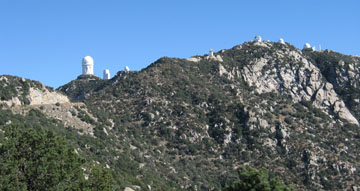 Fig. 3. Kitt Peak National Observatory, our observation site, is located on top of a mountain in southern Arizona (show Google map).  Fig. 4. While our interest in obscure astronomical events is admittedly asymmetric, Maria wouldn't want to miss it.  Fig. 5. We set up our equipment next to one of the observatories with a clear view of the western horizon.  Fig. 6. We met an amateur astronomer from Toronto who also came to observed the transit. |
Completing a Grand Slam of Eclipses There are four basic types of eclipses that can be observed from Earth: solar eclipse, lunar eclipse, Venus transit, and Mercury transit. After our successful trip to observe a solar eclipse, we discovered there would be a conveniently located opportunity to observe a Mercury transit (Fig. 1) and complete a lifetime "grand slam" of eclipses. A Mercury transit occurs when the planet Mercury lines up exactly between Earth and the Sun (Fig. 2). On average, this event happens 13 times each century. While not as spectacular or rare as a Venus transit, a Mercury transit still provides a direct experience of our solar system's scale. If Earth were a pea located at one end of a football field, then Mercury would be a peppercorn located on the opposite 39-yard line. The Sun would be located on the opposite goal line, and it would be almost 1 yard in diameter. The small sizes of Mercury and Earth relative to the involved distances make Mercury transits much less common than solar eclipses. A Mercury transit occurred in the afternoon of November 8, 2006. The entire event was visible from the western United States. When planning any astronomical trip, finding clear skies is a primary concern. We chose Kitt Peak National Observatory (show Google map), located on top of a mountain in southern Arizona (Figs. 3-6). The observatory is home to the world's largest collection of research telescopes, and its location was chosen by the National Science Foundation in 1958 after an extensive survey of possible observatory sites in the U.S. The weather turned out to be a perfect, cloudless day, the best daytime observing conditions we have experienced out of the four eclipse trips we have taken so far. We observed the entire transit as well as the picturesque sunset that followed (Fig. 7). Equipment Details (very optional reading) Since our first eclipse trip (Venus transit in South Africa), we have streamlined our equipment (Fig. 6) and methods. The equipment is now 40% lighter, does not require alignment during the previous night, and can run completely on battery power. Still, John relies on part of Maria's check-in baggage allowance!
(  back to home page) |

|
Fig. 7. Time-lapse movie (8.2 Mb) we made of the entire Mercury transit. In this movie, time has been sped up by a factor of 450, and the Sun appears motionless because the motorized telescope mount tracks it across the sky. There is a sunspot near the edge of the Sun at the 8 o'clock position. It moves slightly during the movie because the Sun rotates around its own axis approximately once per month. During sunset at the end of the movie, the Sun's apparent shape is flattened by atmospheric refraction. Playing this movie requires web browser support of HTML5 video. |
back to home page

